
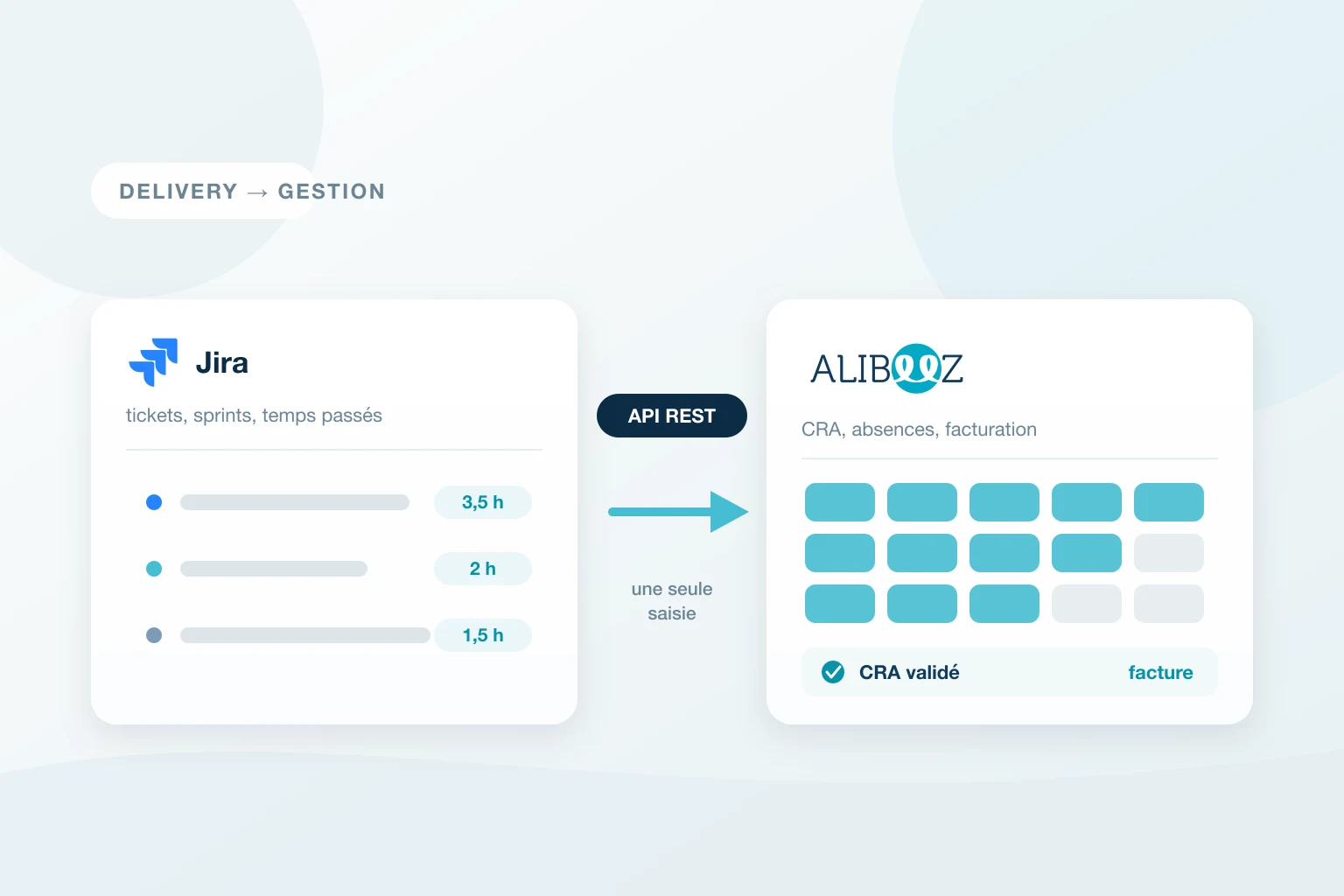
Short answer: connecting Jira to AlibeeZ means pushing the time logged on issues, through the API, into the timesheet, attached to the right project and the right activity. Employees keep logging time where they work; the timesheet arrives pre-filled, with the leave their manager has already approved; month-end becomes a check rather than a re-keying exercise, and invoicing rests directly on the approved timesheet.
Why connect Jira to a management tool?
Because Jira and a management tool describe the same working day, but do not use it for the same thing. Jira knows which issue and which sprint the time went to. Management needs that same time to produce the timesheet, calculate project margin, trigger an invoice and feed payroll.
As long as the two do not talk, somebody bridges them by hand. And the cost of that bridge is not the time it takes, it is the discrepancy it creates. Two versions of the same week always drift apart, and the reconciliation lands at the most expensive moment: the one where the invoice has to go out.
This is why double entry is rarely treated as a mere convenience issue. It is a repository problem: two systems claim to tell the truth about the same data, and nothing arbitrates.
What data travels, and in which direction?
The connection mostly runs one way: Jira stays the project repository, AlibeeZ plugs into it.
| Data | Direction | What it becomes in AlibeeZ |
|---|---|---|
| Time logged on issues | Jira → AlibeeZ | Timesheet lines, attached to project and activity |
| Projects and issues | Jira → AlibeeZ | What the employee is able to book against |
| Approved leave | Internal to AlibeeZ | Already placed on the timesheet, exactly as approved |
| Approved timesheet | Internal to AlibeeZ | The basis for invoicing and margin |
The third row is the one that counts. A timesheet pre-filled with project time alone is still a page to complete: everything that is not project work is missing. Approved leave being there is the difference between "the gaps still need filling in" and "this still needs checking".
What Jira does, and what it does not
The point is not to replace Jira. It is to know where its scope ends.
| Jira | Management tool | |
|---|---|---|
| Issues, sprints, technical progress | Yes | No, and rightly so |
| Time per issue | Yes | Receives it |
| Leave and absences | No | Yes |
| An approved, defensible timesheet | No | Yes |
| Margin by project, by business unit | No | Yes |
| Invoicing, time and materials or fixed price | No | Yes |
| Multi-entity, multi-currency | No | Yes |
In short: Jira describes production, management describes the company. That is exactly the best-of-breed architecture: each tool excellent at its own job, and a core that joins them.
How the connection works
AlibeeZ exposes documented REST APIs, with webhooks. The two mechanisms do different jobs:
- The REST API is what reads and writes the data: time, projects, employees, billing items.
- Webhooks reverse the initiative. Rather than AlibeeZ polling Jira on a fixed schedule, the event is announced when it happens. Less latency, and no empty round trips between two changes.
The real work of a rollout is almost never technical, in any case. It lies in matching the repositories: which management project a given Jira project corresponds to, and which billable activity a given issue type maps to. That mapping table decides whether time lands in the right place, and it is what has to be kept current as new projects start.
Five points to settle before connecting
- Which side wins? If time can be edited on both sides, name the one that prevails. Without that rule, synchronisation does not resolve the conflict, it automates it.
- At what granularity? The issue is useful to delivery, rarely to the invoice. Decide at which level time is aggregated before it reaches the timesheet.
- What about non-project time? Pre-sales, internal meetings, training, bench: none of it exists in Jira, and all of it has to appear on the timesheet.
- What happens after the period closes? Time corrected in Jira once a period is approved needs an explicit rule: reject it, carry it to the next period, or reopen the period.
- Who maintains the mapping? An unmapped new Jira project raises no visible error: it produces time that lands nowhere.
The fourth point is the one most often discovered in production, and the fifth is the most expensive to catch up on.
What changes at month-end
| Without the connection | With the connection | |
|---|---|---|
| Time entry | Twice, in two tools | Once, in Jira |
| End-of-period task | Reconstruct the month | Check and approve |
| Leave | Copied across by hand | Already there, exactly as approved |
| Discrepancies between tools | To be settled before invoicing | Moot: a single source |
| Project margin | Known after consolidation | Follows real progress |
| Invoicing | Waits for consolidation | Starts from the approved timesheet |
On fixed-price projects the effect goes beyond invoicing: reliable time spent is half of the work-remaining equation, and therefore of the forecast.
An example: Actency
Actency delivers more than 10,000 person-days of client projects a year, with Jira as its project repository. By connecting Jira to AlibeeZ through the API, synchronisation is automatic — 50 people over 3 months in under 10 minutes — and time is entered only once: at the end of each period, employees check their timesheet before approving it, and the company then has what it needs to trigger client invoicing.
What if my repository is not Jira?
The reasoning does not change, only the connector does. Links already exist for Stafiz and Kantata, on the staffing and project-management side. Beyond those, the REST APIs cover bespoke cases, and AlibeeZ also offers exports in standard formats (CSV, flat files, and so on) where an API is neither needed nor wanted.
What is already connected, and what each link carries, is listed on the integrations page.
Frequently asked questions
Can Jira be connected to AlibeeZ?
Yes. AlibeeZ exposes documented REST APIs with webhooks, and time logged on Jira issues can feed the timesheet, attached to the right project and the right activity.
Do I have to give up Jira to use a management tool?
No, and that is the opposite of the goal. Jira stays the delivery teams’ project repository; the management tool plugs into it to produce the timesheet, the margin and the invoice, none of which are in Jira’s scope.
How do I avoid double entry between Jira and the timesheet?
By moving time through an API rather than by hand, and by naming one side that prevails. Employees log time where they work, and the timesheet arrives pre-filled, to be checked rather than filled in.
Does leave come from Jira too?
No: leave does not live in Jira. It is managed and approved in AlibeeZ, then placed on the timesheet alongside the project time coming from Jira. It is the combination of the two that makes a timesheet checkable at a glance.
What happens if time is corrected in Jira after the period closes?
That is a rule to set at rollout, not a technical consequence: reject the correction, carry it to the next period, or reopen the period. The choice depends on your approval obligations, but it has to be explicit.
Am I limited to the APIs to work with AlibeeZ?
No. AlibeeZ also offers exports in standard formats (CSV, flat files, and so on), and connectors already exist for other planning tools such as Stafiz and Kantata.